
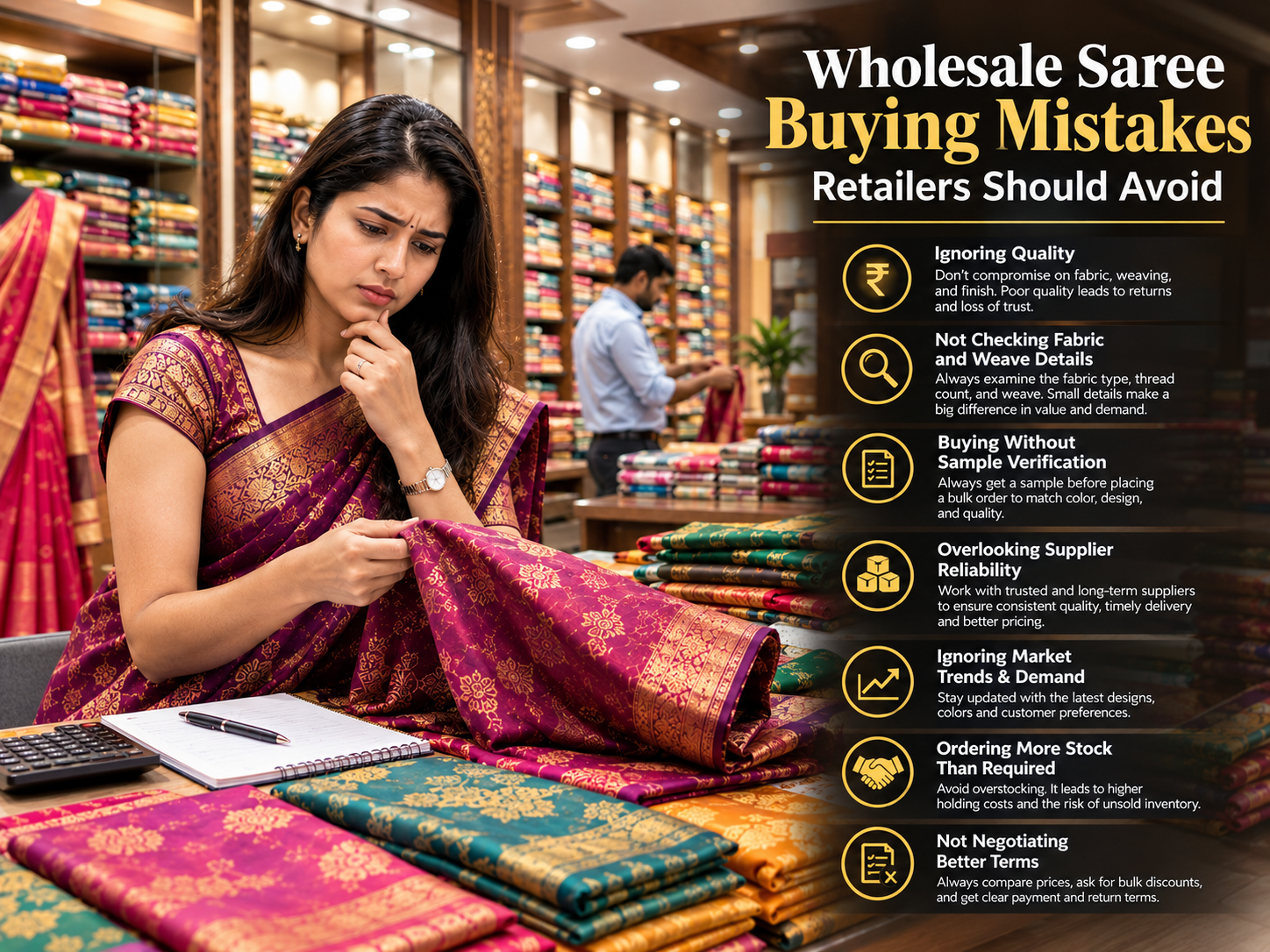
Wholesale Saree Buying Mistakes Retailers Should Avoid
Buying wholesale sarees is an important part of running a successful saree retail business. With hundreds of designs, fabrics, colours and price ranges available in the textile market, retailers have many options to choose from. However, selecting the wrong products or supplier can affect inventory, customer satisfaction and overall business performance.
Whether you are starting a new saree store or already running an established ethnic wear business, avoiding common purchasing mistakes can help you build a more balanced and customer-focused collection. Here are some important mistakes retailers should avoid when buying wholesale sarees in Surat.
1. Buying Sarees Without Understanding Customer Demand
One of the most common mistakes retailers make is purchasing sarees based only on personal preference. A design that looks attractive to the retailer may not necessarily match the preferences of their customers.
Before purchasing in bulk, retailers should understand what their customers usually prefer in terms of fabric, colour, design, occasion and budget. Customer feedback and previous sales can provide useful information for planning future purchases.
2. Focusing Only on Low Price
Wholesale pricing is important for every retailer, but choosing a saree only because it is available at a lower price can create quality-related problems.
Retailers should consider the overall value of the product, including fabric quality, finishing, design, workmanship and customer appeal. A slightly higher purchase price may be suitable when the product offers better quality and presentation.
3. Ignoring Fabric Quality
The fabric plays an important role in the look, comfort and overall value of a saree. Retailers should not select products only by looking at photographs or catalogues.
Whenever possible, check important details such as fabric feel, fall, finishing, print quality, embroidery, border work and overall construction before placing large wholesale orders.
4. Buying Too Many Similar Designs
Another common mistake is purchasing a large quantity of sarees with very similar colours, patterns or designs. While having multiple pieces of a popular design can be useful, excessive repetition can make your collection look limited.
Retailers can create better variety by combining different fabrics, colours, prints, borders, patterns and occasion-based collections.
5. Not Maintaining Different Price Ranges
Every customer has a different budget. A retail store that stocks products within only one price range may miss opportunities to serve different customer segments.
A balanced saree collection can include:
- Budget-friendly sarees
- Regular daily wear collections
- Festive sarees
- Party wear sarees
- Premium sarees
- Designer collections
Maintaining different price segments can give customers more choices while helping retailers serve a wider market.
6. Ignoring Seasonal and Festival Demand
Saree demand can change depending on festivals, wedding seasons and local events. Retailers who do not plan their inventory according to seasonal demand may find it difficult to maintain the right collection at the right time.
Before major festivals and wedding seasons, retailers can plan their wholesale saree collection according to expected customer requirements and popular occasion-wear categories.
7. Not Checking the Supplier's Product Range
Choosing a supplier only because of pricing can be another mistake. Retailers should also look at the supplier's product variety, quality consistency, new design availability and business support.
A reliable wholesale saree supplier in Surat can make regular product sourcing easier and help retailers maintain a diverse collection.
8. Buying Large Quantities Without Testing the Market
When retailers find a new design, there can be a temptation to purchase a large quantity immediately. However, new products should ideally be evaluated based on customer response before making a significant inventory investment.
Starting with a suitable quantity and monitoring customer response can provide useful insights into which designs and categories are performing well in your market.
9. Ignoring New Designs and Changing Fashion Preferences
Customer preferences continue to change. A collection that worked well previously may not always generate the same response in the future.
Retailers should regularly explore new saree designs, colours, fabrics and styling trends while also keeping their best-selling traditional categories.
10. Choosing a Supplier Without Considering Long-Term Business Support
Wholesale purchasing is not only about one transaction. Retailers often need regular stock, new collections and consistent product quality.
Therefore, it is useful to build relationships with suppliers who understand the requirements of retailers and can provide a diverse range of products over time.
How to Make Better Wholesale Saree Buying Decisions
Retailers can follow a simple approach when planning their next wholesale saree purchase:
- Understand your target customers.
- Review your previous sales and fast-moving products.
- Set a clear purchasing budget.
- Compare fabric quality and product finishing.
- Maintain variety across fabrics and designs.
- Keep multiple price segments.
- Plan collections around festivals and wedding seasons.
- Work with reliable wholesale suppliers.
- Test new designs before buying very large quantities.
- Regularly update your inventory.
Why Choosing the Right Wholesale Supplier Matters
A wholesale supplier can play an important role in the success of a retail saree business. Consistent quality, variety, pricing and availability can make inventory planning more efficient.
For retailers searching for wholesale sarees in Surat, choosing an experienced textile business with a diverse ethnic wear collection can provide more options for building a suitable retail range.
Build a Balanced Saree Collection
A successful retail collection does not necessarily mean having the maximum number of products. Instead, it should offer the right combination of variety, quality, pricing and customer-focused designs.
Retailers can consider maintaining a mix of:
Daily Wear + Festive Wear + Party Wear + Designer Sarees + Traditional Sarees + Premium Collections
This approach can help create a collection suitable for different customers and occasions.
Conclusion
Buying wholesale sarees requires careful planning and an understanding of your target market. Avoiding common mistakes such as focusing only on price, ignoring fabric quality, buying excessive quantities or overlooking customer demand can help retailers make more informed purchasing decisions.
For retailers and wholesalers looking for a diverse ethnic wear collection in Surat, Jay Ambe Group Lalaji provides a wide range of sarees and other fashion categories for business requirements.
With the right product selection, supplier relationship and inventory strategy, retailers can create a saree collection that matches their customers' requirements and supports long-term business growth.